IV STAND
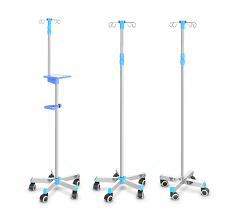
An IV stand, also commonly referred to as an IV pole, is a fundamental piece of medical furniture designed to securely hold and elevate bags of intravenous fluids, medications, or blood products for gravity-fed or pump-assisted administration. Constructed from durable materials like stainless steel or chrome-plated iron, these stands feature a heavy, weighted base—often with four or five casters—to ensure stability and easy mobility around a patient’s bedside or through hospital corridors. The central pole is usually height-adjustable via a manual knob or friction-lock mechanism, allowing healthcare providers to precisely control the infusion pressure by varying the height of the fluid bags relative to the patient’s heart. Most IV stands are equipped with multiple ram’s horn hooks at the top to accommodate several infusions simultaneously and can be fitted with mounting brackets for infusion pumps or oxygen cylinders, making them versatile tools in both clinical and home care settings.
Description
IV Stand (Intravenous Stand)
An IV stand, also known as an intravenous pole or drip stand, is a medical support device
used to hold and suspend intravenous fluid bags, blood products, or infusion pumps at an
appropriate height to allow controlled delivery of fluids and medications into a patient’s
bloodstream by gravity or infusion systems.
Purpose of an IV Stand
- Support IV fluid bags and infusion devices
- Maintain proper height for gravity-assisted flow
- Provide mobility and convenience in patient care areas
- Organize multiple infusion lines safely
Design and Structure
| Component | Function |
|---|---|
| Base with Wheels (Castors) | Ensures stability and easy movement |
| Vertical Adjustable Pole | Allows height adjustment as required |
| Hooks or Hangers | Hold IV fluid bottles, bags, or pumps |
| Locking Mechanism | Secures height adjustment |
Working Principle
The IV stand positions fluid containers above the patient’s venous access site, enabling
gravity to assist the flow of fluids. It can also support electronic infusion pumps that
regulate precise flow rates.
Types of IV Stands
- Fixed height IV stands
- Adjustable height IV stands
- Wall-mounted IV stands
- IV stands integrated with hospital beds
Clinical Applications
- Administration of IV fluids and medications
- Blood transfusions
- Use with infusion and syringe pumps
- Use in wards, ICU, operation theaters, and emergency units
Advantages
- Simple and easy to use
- Portable and stable
- Supports multiple infusions simultaneously
- Durable and easy to clean
Limitations
- May tip if overloaded or unevenly weighted
- Requires space for movement
Conclusion
The IV stand is an essential and fundamental device in healthcare settings, providing safe
and efficient support for intravenous therapy. Its simple design and functionality make it
indispensable in patient care.