
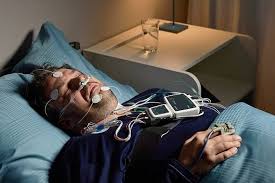
SLEEP STUDY LEVEL 1
A Level 1 sleep study, also known as attended polysomnography (PSG), is the “gold standard” for diagnosing complex sleep disorders and is conducted overnight in a dedicated sleep laboratory or hospital. Unlike home-based tests, it is continuously monitored in real-time by a Registered Polysomnographic Technologist (RPSGT), ensuring that any sensor issues are fixed immediately and that patient safety is maintained throughout the night. This comprehensive test records a minimum of 12 channels of data, including brain activity (EEG) to track sleep stages, eye movements (EOG) for REM detection, muscle activity (EMG) to identify movement disorders, and heart rhythm (ECG). It also captures detailed respiratory information like airflow, breathing effort, and oxygen saturation. Because of its high accuracy and specialized oversight, Level 1 studies are essential for diagnosing conditions that home tests might miss, such as narcolepsy, REM sleep behavior disorder, nocturnal seizures, and complex sleep-related breathing issues.
Description
Sleep Study Level 1 (In-Laboratory Polysomnography – PSG)
A Level 1 sleep study, also known as attended in-laboratory polysomnography (PSG), is the most
comprehensive and gold-standard diagnostic test for evaluating sleep disorders. It is conducted
overnight in a dedicated sleep laboratory under the continuous supervision of a trained sleep
technologist who monitors the patient and the equipment throughout the study.
Purpose of Level 1 Sleep Study
- Comprehensive diagnosis of sleep disorders
- Evaluation of obstructive, central, and complex sleep apnea
- Assessment of sleep architecture and stages
- Diagnosis of parasomnias, periodic limb movement disorder, and narcolepsy (with MSLT)
- CPAP/BiPAP titration when required
Parameters Monitored
| Parameter | Purpose |
|---|---|
| EEG (Electroencephalogram) | Determine sleep stages and arousals |
| EOG (Electrooculogram) | Detect REM sleep |
| EMG (Chin and limb leads) | Muscle tone and limb movement detection |
| ECG | Cardiac rhythm monitoring |
| Airflow (nasal pressure & thermistor) | Detect apneas and hypopneas |
| Respiratory Effort Belts | Differentiate obstructive vs central events |
| Pulse Oximetry (SpO₂) | Monitor oxygen desaturation |
| Snore Microphone | Record snoring |
| Body Position Sensor | Assess positional sleep apnea |
| Video and Audio Recording | Observe movements, behaviors, and parasomnias |
Procedure
- Patient arrives at the sleep laboratory in the evening
- Sensors and electrodes are applied by a technologist
- Continuous monitoring overnight with real-time observation
- Technologist can intervene if sensors detach or issues arise
making Level 1 PSG the most accurate sleep study type.
Data Analysis and Reporting
- Sleep stages and architecture
- Apnea-Hypopnea Index (AHI)
- Oxygen Desaturation Index (ODI)
- Arousals, limb movements, and parasomnias
- Cardiac rhythm abnormalities
Indications
- Complex or unclear sleep disorder diagnosis
- Suspected central sleep apnea or parasomnias
- Failed or inconclusive home sleep tests
- CPAP/BiPAP titration studies
Advantages
- Most comprehensive and accurate sleep evaluation
- Real-time supervision and troubleshooting
- Video documentation of sleep behavior
Limitations
- Higher cost compared to home studies
- Sleeping in an unfamiliar environment
Conclusion
Level 1 polysomnography remains the gold standard for diagnosing a wide range of sleep disorders.
Its comprehensive monitoring and technologist supervision provide the highest quality diagnostic data.