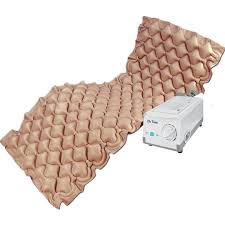
AIRBED
An airbed, or medical air mattress, is a specialized pressure-relief surface designed primarily to prevent and treat pressure ulcers (bedsores) in patients with limited mobility or those confined to bed for long periods. These systems typically utilize alternating pressure therapy, where a series of individual air cells are rhythmically inflated and deflated by an automated electric pump to redistribute body weight and improve blood circulation to the skin. Many models also feature low air loss technology, which uses tiny laser-cut holes to circulate air under the patient, reducing heat and moisture buildup to keep the skin dry and healthy. By constantly changing the contact points between the body and the mattress, airbeds provide a dynamic support surface that significantly reduces tissue interface pressure compared to standard foam mattresses.
Description
Airbed (Alternating Pressure Mattress)
An airbed, commonly referred to as an alternating pressure mattress, is a medical support
surface designed to prevent and manage pressure ulcers (bedsores) in patients who are
bedridden or have limited mobility. The mattress uses air-filled cells that inflate and
deflate cyclically to redistribute pressure across different areas of the body.
Purpose of an Airbed
- Prevent development of pressure ulcers
- Relieve prolonged pressure on bony prominences
- Improve blood circulation in tissues
- Enhance patient comfort during long-term bed rest
Principle of Operation
The airbed operates on the principle of alternating pressure therapy. Air cells within the
mattress inflate and deflate in a timed sequence using an electric air pump. This shifting
of pressure points reduces constant pressure on any single area of the body, thereby
minimizing the risk of tissue ischemia and skin breakdown.
Main Components
| Component | Function |
|---|---|
| Air Mattress with Multiple Cells | Provides pressure redistribution through air chambers |
| Electric Air Pump | Controls inflation and deflation cycles |
| Air Tubing | Connects pump to mattress cells |
| Control Panel | Adjusts pressure settings and cycle timing |
Working Cycle
- Alternate rows of air cells inflate while others deflate
- Cycle repeats every few minutes automatically
- Pressure shifts from one body area to another
Clinical Indications
- Bedridden patients
- Patients with spinal injuries or paralysis
- Post-operative patients with limited mobility
- Patients at high risk for pressure ulcer development
Advantages
- Reduces risk of bedsores
- Improves patient comfort
- Easy to install on standard hospital beds
- Adjustable pressure settings
Limitations
- Requires continuous power supply
- Noise from the pump may disturb some patients
- Regular maintenance and cleaning required
Conclusion
An airbed is an essential medical support device for pressure ulcer prevention and patient
comfort in long-term care settings. Its alternating pressure mechanism plays a vital role in
protecting skin integrity in immobile patients.